Basingstoke sits at roughly 100 metres above sea level, straddling the transition between the chalk of the North Downs and the London Clay that thickens towards the Thames Basin. Anyone who has walked the footpaths around Old Basing or up towards Sherborne St John knows the landscape isn't flat. That gentle undulation is part of the town's character, but it also means that a good number of building plots and road alignments involve cut slopes, retained fills, or embankments. A slope stability analysis here isn't a box-ticking exercise. The interaction between weathered chalk, clay-with-flints, and perched groundwater can produce failure modes that look benign right up until a wet winter tips the balance. We've reviewed enough sites across Basingstoke to know that the desk study and the walkover often tell you more than the borehole log alone. Where the ground profile is complex, we frequently combine our slope assessment with test pits to map the clay-chalk interface and CPT testing to resolve soft zones that a trial pit might miss.
The chalk-clay interface around Basingstoke creates a perched groundwater regime that can halve the factor of safety between August and February.
Our approach and scope
Site-specific factors
BS EN 1997-1:2004, implemented through the UK National Annex, sets out the framework for geotechnical design including slope stability. For Basingstoke, the most consequential risk is rarely a deep-seated rotational failure in intact material. It's the shallow translational slide along the weathered chalk surface, or a wedge failure controlled by jointing in the upper chalk beds. The town's expansion has pushed development onto sites that were historically avoided—valley sides with a history of spring activity, former chalk quarries backfilled with unknown material, and railway embankments dating from the London and South Western Railway era. When the ground investigation misses a thin softened layer at the base of the clay-with-flints, the resulting design can be unconservative by a wide margin. Even a modest slope can catch out a site if drainage isn't detailed properly. That's why we insist on integrating the slope stability analysis with the wider earthworks specification, so the contractor understands that a 1.3 factor of safety on paper can become 0.95 if the crest drain isn't installed before the first autumn rain.
Video resource
Relevant standards
BS EN 1997-1:2004 (Eurocode 7) + UK National Annex, BS 5930:2015+A1:2020 Code of practice for ground investigations, CIRIA C760 (2017) Guidance on embedded retaining wall design
Other technical services
Cut and fill slope assessment
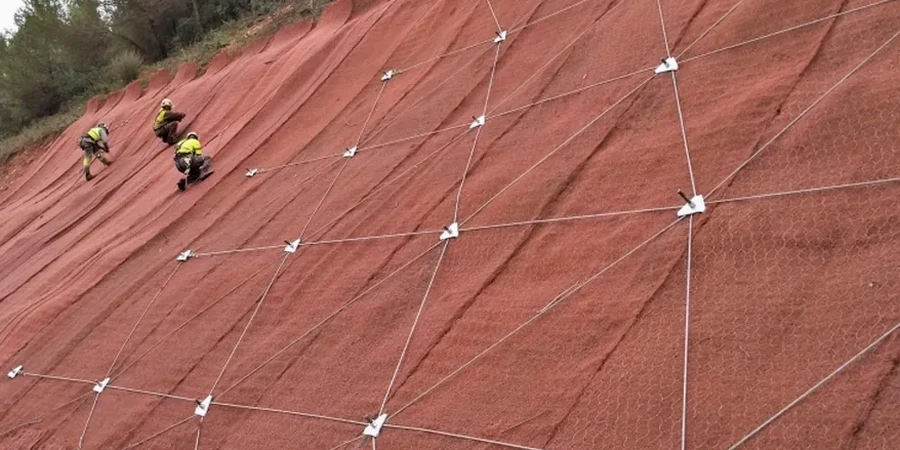
For residential plots, road widening schemes, and commercial earthworks across Basingstoke, we analyse proposed cut and fill profiles against the site-specific ground model. This includes back-analysis of any existing instability features, parameter selection from laboratory and in-situ testing, and recommendations for drainage, benching, or reinforcement if the factor of safety falls below the target threshold.
Embankment and infrastructure slope review
Basingstoke has a network of railway embankments, motorway cuttings, and flood defence bunds that require periodic stability review. We assess these under current loading and groundwater conditions, often supplementing the analysis with inclinometer monitoring data and pore pressure readings to calibrate the model against observed behaviour.
Typical parameters
Questions and answers
How much does a slope stability analysis cost for a typical Basingstoke site?
For a straightforward residential cut slope or small embankment in the Basingstoke area, the analysis and reporting typically falls between £960 and £3,500 depending on the complexity of the ground profile, whether laboratory testing is required, and the number of cross-sections that need to be modelled. A desk study combined with a single critical section analysis sits at the lower end, while a multi-section assessment with back-analysis of existing slips and sensitivity runs moves towards the upper end.
What ground investigation data do you need before starting a slope stability analysis?
At minimum, we expect borehole or trial pit logs with SPT values, laboratory classification and shear strength results (triaxial or shear box), and groundwater monitoring over at least one season. For Basingstoke sites on the chalk-clay transition, we place particular emphasis on the exact depth of the weathered chalk surface and any evidence of a perched water table, because that interface often governs the critical failure surface.
Do you need to consider seismic loading for slopes in Basingstoke?
Seismic loading is not a routine design requirement for UK slopes under current practice, as the seismic hazard is low to moderate. We sometimes run a sensitivity check with a horizontal coefficient of 0.015 to 0.025 for high-consequence infrastructure, but for the vast majority of residential and commercial projects in Basingstoke, the governing case is static with adverse groundwater.
What's the difference between a limit equilibrium analysis and a finite element analysis for slope stability?
Limit equilibrium methods (Bishop, Spencer, Morgenstern-Price) are the industry standard for most slope stability assessments because they are well-calibrated against case histories and accepted by regulators. They give a clear factor of safety for a predefined slip surface. Finite element analysis can model progressive failure and deformation but requires significantly more input data. For the London Clay and chalk formations around Basingstoke, we find limit equilibrium with careful parameter selection gives solid, defensible results for most design situations.
How long does a slope stability analysis take from instruction to report?
A typical turnaround for a single-slope assessment on a Basingstoke site is two to three weeks, assuming the ground investigation data is already available. If we need to commission additional laboratory testing—for example, multi-stage triaxial tests on London Clay or chalk—that can add another three to four weeks. We always aim to align the reporting timeline with the design team's programme, so the analysis feeds into the detailed design without delaying the tender package.