Basingstoke's transformation from a quiet market town to a major London overspill destination during the 1960s and 70s left a legacy of rapid residential expansion over variable ground. The underlying geology here shifts dramatically across short distances: chalk to the north and east, London Clay formations toward the south, and pockets of river terrace gravels along the Loddon Valley. This patchwork means compaction acceptance on one side of town tells you nothing about what to expect three miles away. Our laboratory team has worked on everything from piled foundations in the clay-heavy Kempshott area to granular fill compaction behind the retail parks near junction 6 of the M3. When we carry out a sand cone test, we are not just running a procedure — we are verifying that the ground beneath a structure in this specific part of Basingstoke actually meets the specification written on the drawing. For projects where deeper layer characterisation is needed before placing fill, we also provide in-situ permeability testing to assess drainage behaviour in the chalk.
Compaction is not about how many roller passes you count — it is about whether the dry density in the ground matches what the Proctor curve says it should be.
Our approach and scope
Site-specific factors
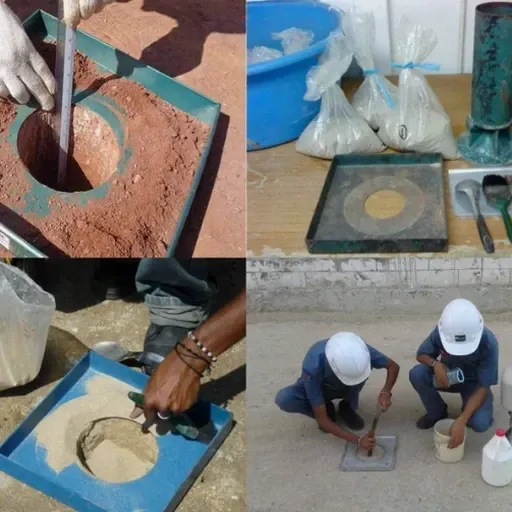
The sand cone apparatus itself is deceptively simple: a one-gallon plastic or glass jar threaded onto a metal cone with a brass valve, a base plate with a machined circular opening, and a bag of carefully graded silica sand. Out in Basingstoke on a windy February morning with drizzle coming sideways across the site, that simplicity disappears fast. If the sand gets damp before it leaves the jar, the bulk density calibration is ruined and every calculation that follows will be wrong. On the chalk formations north of town, we contend with flint nodules that can collapse the test hole walls mid-excavation, requiring the test to be abandoned and relocated. In the London Clay areas south of the M3, the opposite problem occurs: the clay is so stiff that cutting a clean cylindrical hole without smearing the sides takes real patience. The biggest risk by far is vibration from nearby plant: a passing articulated dump truck can shake loose sand grains from the cone before the valve is closed, introducing an error that can push a failing test into passing territory. We always pause testing when heavy machinery is within 20 metres of the test location.
Relevant standards
BS EN 1997-2:2007 (Eurocode 7 – Ground investigation and testing), BS 1377-9:1990 (In-situ density tests – sand replacement method), Manual of Contract Documents for Highway Works (MCHW), Series 600 – Earthworks, BS 1377 (Standard Test Method for Density of Soil in Place by the Sand-Cone Method – referenced for calibration procedures)
Other technical services
Proctor compaction testing (lab reference)
Before we can calculate relative compaction on site, we need the Proctor curve. We run standard or modified Proctor tests on the fill material in our laboratory to determine maximum dry density and optimum moisture content — the benchmarks against which every sand cone result is judged.
Plate bearing tests for formation verification
On the chalk formations common around Basingstoke, compaction is only half the story. We carry out plate load tests to measure the bearing capacity and modulus of subgrade reaction directly, giving the structural engineer confidence that the formation can support the design loads.
Nuclear density gauge testing (rapid screening)
For large earthworks where sand cone testing alone would take days, we deploy nuclear density gauges for rapid screening across the lift, then calibrate the gauge readings against sand cone reference tests at selected locations.
Typical parameters
Questions and answers
How much does a sand cone density test cost in Basingstoke?
Field density testing using the sand cone method in the Basingstoke area typically ranges from £80 to £110 per individual test point, assuming reasonable site access and multiple tests carried out during the same mobilisation. The rate varies depending on the number of tests per visit, travel distance within Hampshire, and whether laboratory Proctor reference testing is also required to calculate relative compaction. We provide a firm quote once we understand the project scope and fill material type.
How long does a single sand cone test take on site?
A single sand cone test at one location takes approximately 20 to 30 minutes from setting up the base plate through to bagging the excavated soil. That assumes the hole excavation goes smoothly and we are not delayed by vibration from nearby plant. On chalky ground with flints, or in stiff London Clay south of Basingstoke, the excavation step can take longer. We can typically complete 8 to 12 points in a standard working day depending on the distance between test locations across the site.
What is the difference between the sand cone method and a nuclear density gauge?
The sand cone method is a direct measurement: we excavate a known volume of soil, weigh it, and calculate density from mass and volume. A nuclear density gauge measures density indirectly by detecting how much radiation is backscattered or transmitted through the soil. The sand cone is slower but is considered the reference method in UK earthworks specifications. Nuclear gauges are faster for screening but require calibration against sand cone results on the same material, and they need a trained radiation protection supervisor on site.
What moisture condition is acceptable for fill compaction in this area?
For the soils we encounter across Basingstoke — chalk, London Clay, and river gravels — the acceptable moisture range is typically within ±2% of the optimum moisture content determined by the Proctor test. Chalk fill is particularly sensitive: too wet and it becomes putty-like under the roller, too dry and it will not bind. We always recommend moisture conditioning trials at the stockpile before placing the first lift, especially on the chalk formations north and east of the town where winter rainfall can saturate the fill before it even reaches the compaction plant.