The London Clay and overlying Bagshot Beds beneath Basingstoke create a layered profile where fine-grained silts sit directly on stiff, fissured clay. Getting the particle size distribution right here means you can forecast drainage behaviour and bearing capacity before a single footing goes in. We run the full BS 1377-2 suite: wet and dry sieving for the coarse fraction, plus a hydrometer sedimentation analysis to capture silt and clay percentages below 63 microns. The combined curve gives you D10, D30, D60, and the uniformity coefficient in one report, which feeds straight into filter design, earthworks specification, and pavement layer assessment where the subgrade gradation dictates the entire CBR performance envelope.
We report D10, D30, D60, and the coefficient of uniformity so your earthworks spec is grounded in numbers, not assumptions.
Our approach and scope
Site-specific factors
Basingstoke's post-war expansion pushed residential estates onto the clay-with-flints that caps the chalk in the southern parishes. These head deposits are notoriously gap-graded: plenty of gravel-sized flint nodules in a sticky clay matrix. A quick visual classification can mislead you into treating the material as a well-graded granular fill, but the hydrometer curve usually reveals 40 percent fines or more. When the fines are plastic, as they often are in the Reading Formation remnants, the fill collapses under repeated wetting. The grading curve becomes your early warning: if the coefficient of uniformity exceeds 10 but the fines content stays above 35 percent, the material is borderline for compaction and drainage. That single data point changes the earthworks strategy from standard end-tipping to a moisture-conditioned placement with closely spaced nuclear density checks.
Relevant standards
BS 1377-2:1990 (Wet sieving and hydrometer sedimentation), BS EN ISO 17892-4:2016 (Geotechnical investigation — Laboratory testing — Particle size distribution), Eurocode 7 BS EN 1997-2:2007 (Ground investigation and testing)
Other technical services
Combined Sieve and Hydrometer (PSD Full Suite)
The complete particle size distribution from 75 mm down to 2 μm. Wet sieving captures the gravel and sand fractions; the hydrometer sedimentation run gives you silt and clay percentages to the nearest 0.5 percent. This is the go-to package for earthworks specification, drainage blanket design, and concrete aggregate suitability checks on Basingstoke sites where the superficial geology includes river terrace deposits or clay-with-flints.
Sieve-Only Analysis (Coarse Fraction)
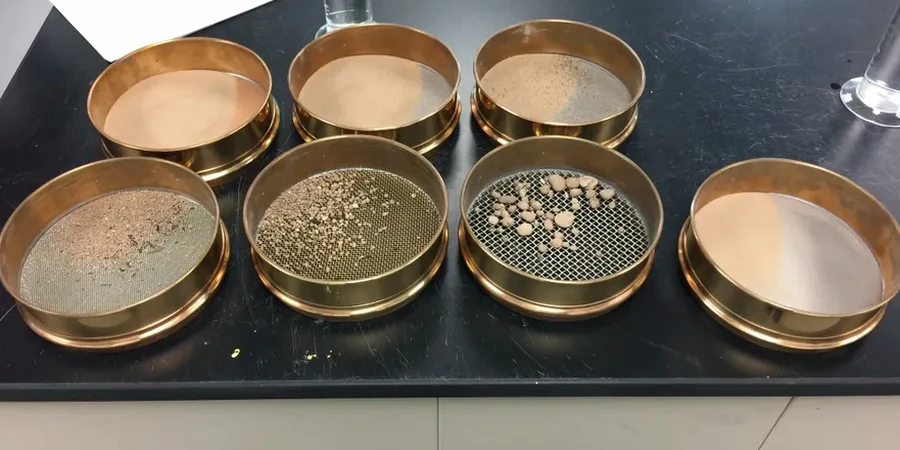
For clean sands and gravels where the fines content is visibly below 5 percent, a sieve-only run to BS 1377-2 saves time and budget. We use a full nest of 200 mm diameter sieves with mechanical shaking for 10 minutes minimum. Suitable for imported granular fill verification and sub-base acceptance testing when the specification requires a grading envelope check without the hydrometer stage.
Typical parameters
Questions and answers
How much does a particle size distribution test cost for a Basingstoke project?
For a combined sieve and hydrometer analysis to BS 1377-2, budget between £80 and £140 per sample depending on whether you need the full sedimentation suite or a sieve-only run. The price includes sample preparation, oven drying, the complete set of sieve and hydrometer readings, and the final report with the grading curve charted. Multiple samples from the same borehole or trial pit usually attract a reduced rate per sample.
How should I prepare and transport soil samples for grading analysis from a Basingstoke site?
Keep the sample in a sealed heavy-duty polythene bag inside a rigid container to prevent moisture loss and cross-contamination during transport. We need a minimum of 1 kg for fine soils and 2 kg for sandy or gravelly material, though larger masses improve representativeness. Label the container with the project name, sample depth, and date of sampling. Avoid exposing the bag to direct sunlight for extended periods; the lab is in Basingstoke and we can arrange same-day drop-off if the sample arrives before 14:00.
Can the hydrometer analysis detect organic content or just the mineral grain sizes?
The hydrometer method measures the sedimentation velocity of solid particles suspended in a dispersant solution, so it reflects the equivalent spherical diameter of all solid grains, including fine organic fragments. However, it does not quantify organic content directly. If the sample is from a Basingstoke site with known peat or organic silts, we recommend running a loss on ignition test alongside the hydrometer analysis so you can separate the mineral fines from the combustible fraction and get a true mineral-only grading curve.