The ground in Basingstoke rarely gives up its secrets easily. You see it on every site, from the London Clay that swells and shrinks with the seasons to pockets of loose Bagshot Sand that can catch out a standard borehole log. A CPT test cuts through that uncertainty. It gives us a continuous vertical profile of the soil's response under load. No gaps. No disturbed samples. Just a real-time trace that tells you exactly where the soft layers sit and how dense the bearing stratum really is. In a town where development pressure keeps pushing into former farmland and brownfield plots, that level of resolution saves time and avoids costly over-design.
A CPT trace is the closest thing we have to reading the ground like a book – every peak and trough tells a story about depositional history.
Our approach and scope
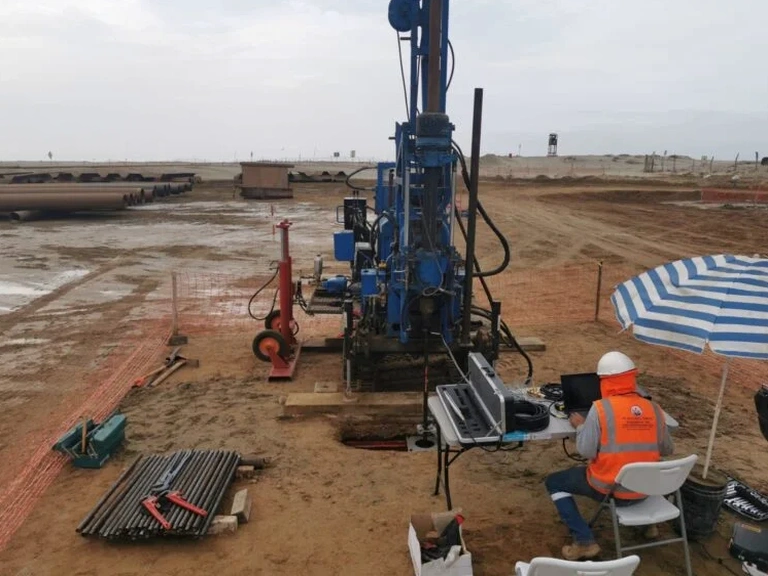
Site-specific factors
BS EN 1997-2:2007 Section 4.3 makes it clear: derived parameter values shall be calibrated against local experience. In Basingstoke that means understanding the London Clay's overconsolidated behaviour. CPT correlation factors that work well in normally consolidated clays will overestimate Su here, sometimes by 30% or more. We apply the Lunne et al. (1997) approach with Nkt factors calibrated against local triaxial data. For sites near the River Loddon or the upper reaches of the Test, pore pressure dissipation data becomes critical. A fast decay indicates silty drainage paths. A slow decay suggests a more homogeneous clay mass. Misreading either can lead to an undrained analysis where a drained failure mechanism actually controls the design.
Relevant standards
The applicable standards include BS EN ISO 22476-1:2012 for
Other technical services
Standard CPTu Sounding
Continuous measurement of cone resistance, sleeve friction, and dynamic pore pressure. We provide soil behaviour type classification using the Robertson (1990) chart updated with normalised parameters. Each log includes corrected cone resistance qt and friction ratio Rf plotted against depth.
Dissipation Test Programme
Pore pressure decay monitored at selected depths during a CPT stop. This gives you the coefficient of consolidation in horizontal flow, which is essential for predicting settlement rates in clay strata under embankment loading or raft foundations.
CPT-Based Foundation Parameter Report
A geotechnical interpretative report that translates the CPT traces into design parameters: undrained shear strength profiles, relative density for granular layers, constrained modulus for settlement calculations, and liquefaction screening where the water table is high.
Typical parameters
Questions and answers
How much does a CPT test cost in Basingstoke?
For a standard CPTu sounding in the Basingstoke area, budget between £140 and £230 per metre of penetration. The exact rate depends on access conditions, depth required, and whether we need to pre-drill through hard gravel layers. Mobilisation to site is charged separately and depends on distance from our nearest depot. We provide fixed-price quotes once we have reviewed the site location and ground conditions.
Can CPT replace boreholes entirely on a Basingstoke site?
It depends on the geology. In the Bagshot Sand or the chalk, CPT can cover a lot of the ground investigation scope, especially for shallow foundations. But in the London Clay, you still need at least one borehole with thin-walled sampling for calibration. We advise clients to think of CPT and boreholes as complementary tools, not competitors. The CPT gives you continuous data; the borehole gives you samples for classification and strength testing.
What depth can you reach with CPT in Basingstoke soils?
In the London Clay we routinely reach 25 to 30 metres without any issues. The clay is stiff but consistent and the cone pushes through smoothly. In areas with dense gravel lenses, refusal can occur shallower. We carry a pre-drilling auger on the rig to get through gravel caps when necessary. The chalk, which underlies much of the area at depth, can also cause refusal if it is weathered but intact.
Do you provide interpreted soil behaviour type logs from the CPT data?
Yes. Every CPT log we issue includes the Robertson (1990) soil behaviour type classification based on normalised cone resistance and friction ratio. We also provide an interpretative section that maps the SBT categories to conventional soil descriptions for use in your ground model. The raw data is always included so you can run your own correlations if preferred.