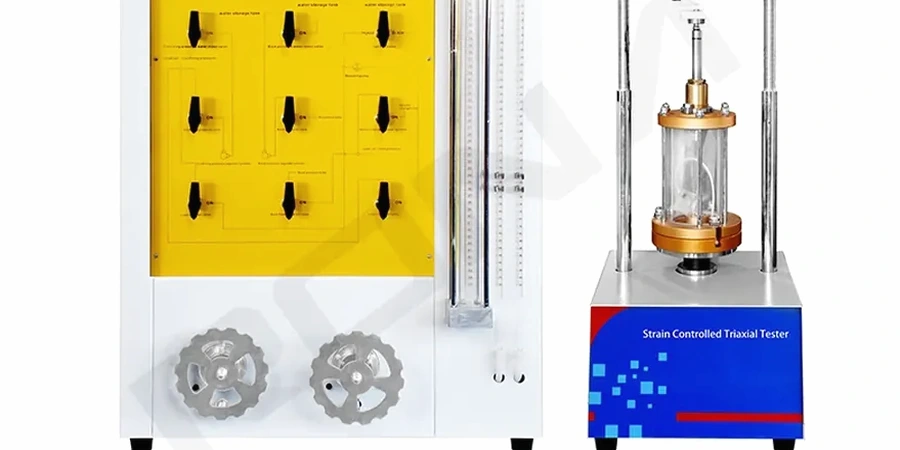
The Cretaceous chalk beneath Basingstoke dictates a lot of what we see in the lab. Samples come in from sites across the town, and the intact chalk strength varies more than people expect. A borehole near the railway station might give competent Grade I chalk, while two miles east near the M3 junction we get highly weathered Grade III material. The triaxial test is what separates these. We consolidate specimens to effective confining pressures representing depth, then shear them to get c' and phi' — the drained shear strength parameters that every foundation and slope design depends on. Without this, assumptions about chalk behaviour are just guesswork. Our laboratory runs three triaxial frames capable of handling 38 mm to 100 mm diameter specimens, which matters when you are dealing with flint bands that make sample trimming a real challenge.
Chalk and London Clay respond differently to shear. One test on each formation from the same Basingstoke site often reveals a factor of two difference in soil stiffness.
Our approach and scope
Site-specific factors
Basingstoke expanded fast in the 1960s and 70s under the Town Development Act, with large residential estates and commercial parks built on land that had not been thoroughly investigated. Some of that early development sits on dry valleys in the chalk where the ground is softer than expected. We have seen triaxial results from samples in these areas where the effective cohesion is near zero because the chalk fabric has been destroyed by periglacial weathering. If you are designing a multi-storey structure on a site like that, using textbook chalk parameters is a mistake. The triaxial test gives you the real numbers. For piling through chalk, we also look at the drained stiffness at small strains, because chalk can strain-soften and lose shaft friction if the pile installation technique disturbs the soil structure. The CPT test complements this by providing a continuous profile of tip resistance, but only the triaxial gives you the shear strength parameters needed for numerical modelling of pile-soil interaction.
Relevant standards
BS 1377-7:1990, BS 1377-8:1990, BS EN 1997-2:2007 (Eurocode 7 – Ground investigation and testing), BS 5930:2015+A1:2020
Other technical services
Consolidated Drained (CD) Triaxial
Slow shearing with full drainage. The standard test for chalk and stiff clays when we need effective stress parameters for long-term slope or foundation design.
Consolidated Undrained (CIU) with Pore Pressure
Shearing without drainage while measuring excess pore pressure. We use this for London Clay to get both undrained shear strength and effective stress parameters from one test.
Unconsolidated Undrained (UU) Triaxial
Quick test for total stress analysis. Useful for short-term stability of excavations in clay, where construction loads are applied faster than the soil can drain.
Stiffness Modulus from Local Strain
We instrument specimens with local strain transducers to measure small-strain stiffness (E0, E50). Essential data for settlement prediction under footings and mats.
Typical parameters
Questions and answers
How long does a drained triaxial test on Basingstoke chalk typically take?
A consolidated drained test on chalk usually runs between 5 and 10 days from specimen preparation to final report. The shearing stage alone takes 3 to 5 days because we shear at very slow rates — typically 0.001 to 0.005 mm per minute — to prevent pore pressure build-up. London Clay takes longer, sometimes 10 to 14 days, because the permeability is much lower and we must ensure full drainage.
What is the cost of a triaxial test?
A single CIU or UU triaxial test typically falls in the range of £1,560 to £1,920, depending on specimen size and the number of consolidation stages. A CD test on chalk or clay sits at the upper end of that range due to the longer shearing time. We provide a detailed quote once we know the number of specimens and the required confining pressures.
Do you need undisturbed samples for the triaxial test, or can remoulded specimens be used?
For effective stress parameters (c' and phi') we need undisturbed samples — thin-walled tube samples from boreholes, taken and handled according to BS EN ISO 22475-1. Remoulded specimens are only used for UU tests or when the project specifically requires testing of compacted fill. The sample quality is critical for chalk; we reject specimens with visible fissuring or flint damage before trimming.