A contractor working on a mixed-use development near Basing View recently hit groundwater three metres earlier than the borehole logs suggested. The site straddled the boundary between the London Clay Formation and the overlying river terrace gravels of the River Loddon—a classic Basingstoke scenario where perched water tables can catch even experienced groundworkers by surprise. Rather than halting the excavation for weeks, the team supplemented the original desk study with targeted laboratory testing on undisturbed samples taken from the critical transition zone. Triaxial shear tests under consolidated-undrained conditions showed that the clay retained good effective stress parameters despite the saturation, and the foundation design was adjusted within the original programme. In Basingstoke, where the geology shifts from stiff fissured clays to weathered chalk within the span of a single industrial estate, a solid soil mechanics study is not a tick-box exercise. It is the difference between a foundation that works with the ground and one that fights it from day one. Our laboratory in the South East processes samples from across Basingstoke—from Chineham to Hatch Warren—providing the BS 5930 and Eurocode 7 compliant data that structural engineers need to make confident decisions. When the site investigation reveals tricky transitional ground, we often recommend pairing the laboratory programme with an in-situ permeability assessment to quantify the drainage characteristics that govern both temporary works and long-term performance.
Effective stress parameters from triaxial testing on London Clay samples can reduce foundation sizes by 15–25% compared to total stress design, simply by accounting for the suction that exists above the water table.
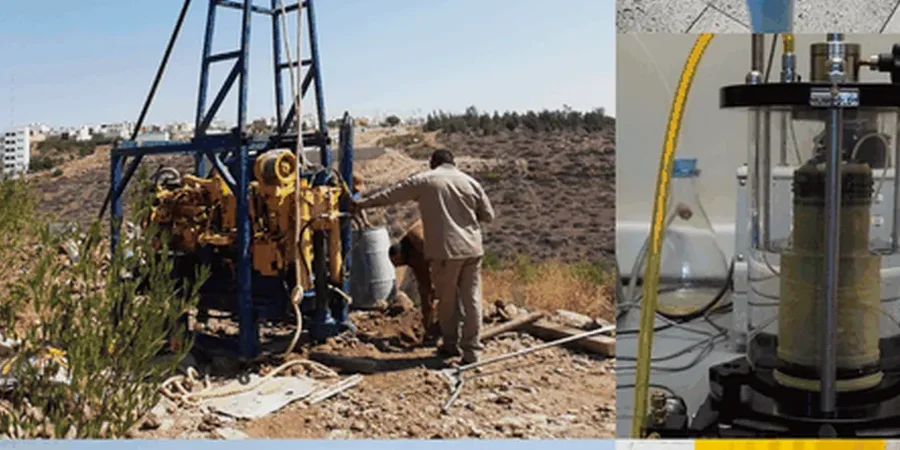
Our approach and scope
Site-specific factors
The most expensive geotechnical problem we see in Basingstoke is not soft ground—it is differential settlement caused by inadequate characterisation of the London Clay's desiccated crust. In the upper two to three metres, the clay is weathered, fissured, and often significantly stiffer than the material below. If the whole profile is treated as homogeneous based on a single average SPT N-value, shallow foundations can end up bridging across the stiff crust while the intact clay beneath consolidates under load, producing the kind of angular distortion that cracks masonry and misaligns lift rails. The CIRIA C760 guidance on buried structures is clear: the stiffness profile matters, not the average. Another Basingstoke-specific risk is sulphate attack on buried concrete. The London Clay contains pyrite that oxidises to produce sulphate concentrations high enough to require sulphate-resisting cement in some locations, particularly where the groundwater regime fluctuates seasonally and introduces oxygen into reduced zones. The soil mechanics study quantifies these risks through chemical testing (pH, sulphate, magnesium) alongside the mechanical parameters, giving the structural engineer a complete picture rather than a fragmented one. And where the chalk is present at foundation level, the risk shifts to the unpredictable occurrence of dissolution features—pipes and sinkholes that can open up during excavation and demand rapid re-assessment of the bearing stratum.
Relevant standards
BS 5930:2015+A1:2020 provides the code of practice for ground investigations, while BS EN 1997-1:2004 (Eurocode 7) governs geotechnical design general rules. BS 1377:2018 specifies test methods for soils in civil engineering, BRE Special Digest 1 (SD1) addresses concrete in aggressive ground, and CIRIA C760 offers guidance on embedded retaining wall design.
Other technical services
Triaxial Compression Testing
Consolidated-undrained (CU) and consolidated-drained (CD) triaxial tests on 100 mm diameter specimens to determine effective stress shear strength parameters. Essential for modelling the London Clay's behaviour at depths where fissures and fabric control the failure mode.
Oedometer Consolidation Testing
One-dimensional compression tests to measure settlement parameters: compression index (Cc), recompression index (Cr), and coefficient of consolidation (cv). Critical for estimating the magnitude and rate of settlement under embankment and foundation loads.
Chemical and Sulphate Analysis
pH, water-soluble sulphate, total potential sulphate, and magnesium content are evaluated in accordance with BRE SD1 methodology. This determines the Design Sulphate Class and the associated concrete specification for buried elements within Basingstoke's pyritic London Clay.
Classification and Index Testing
Moisture content, Atterberg limits, particle size distribution by wet sieving and sedimentation, and bulk/ dry density. These index tests provide the baseline description and allow the engineering team to correlate strength and stiffness parameters across the site.
Typical parameters
Questions and answers
How long does a full soil mechanics study take for a typical Basingstoke brownfield site?
For a programme comprising classification tests, triaxial compression, oedometer consolidation, and chemical analysis on 6–10 samples, we typically deliver the final factual report within 10–14 working days from sample receipt. Triaxial testing requires the longest lead time because each specimen must be saturated, consolidated, and sheared at a controlled strain rate—the CU test sequence alone takes 3–5 days per specimen. If the project is on a tight programme, we can issue interim results for the classification and chemical tests within 5 working days so that concrete specification and preliminary foundation sizing can proceed while the strength testing completes.
What does a soil mechanics study cost for a single-storey extension in Basingstoke?
For a residential extension on London Clay, the laboratory testing component of a soil mechanics study typically falls in the range of £2,170 to £3,740, depending on the number of samples and the specific tests required. A basic programme might include moisture content, Atterberg limits, particle size distribution, and one-dimensional oedometer consolidation on two samples. If the building control officer requires sulphate and pH testing—common in Basingstoke due to the pyritic nature of the local clay—that adds a modest increment. The triaxial testing usually is not required for single-storey domestic work unless the ground conditions are particularly variable or the design includes significant retaining elements.
Can you test chalk samples from Basingstoke sites, and how does the approach differ from clay testing?
Absolutely—chalk testing is a significant part of our workload for Basingstoke projects, particularly those in the Popley, Oakley, and Kempshott areas where the White Chalk Subgroup is at or near the surface. The approach differs from clay testing in several important ways. Intact chalk specimens are extremely difficult to recover and trim without disturbance; we use thin-walled sampling tubes driven slowly with a constant rate of penetration and trim the specimens under controlled humidity. The key parameters we measure are intact dry density, porosity, and unconfined compressive strength, which together define the chalk's weathering grade per the CIRIA C574 classification. Saturation is critical—chalk loses significant strength when wetted, so we test at natural moisture content and also after saturation to bracket the in-service behaviour. For foundation design, we often run a series of point load tests alongside the UCS to build a correlation that can be used to interpret the weaker zones identified in the borehole logs.