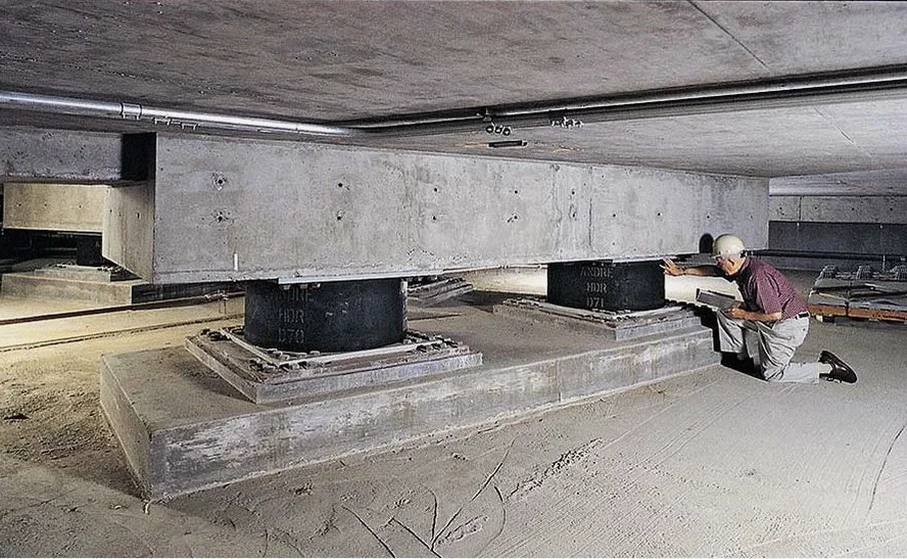
A developer we worked with near Basing View had a steel-framed office block that kept failing the displacement checks under the seismic load case — even though Hampshire isn't the first place you'd think of for earthquake risk. The issue wasn't the frame; it was the stiff clay beneath it transmitting more ground motion than the original structural model assumed. Base isolation changed the equation completely. Instead of beefing up every beam and column, we introduced elastomeric isolators at foundation level that let the ground move while the building stayed put. It's a counter-intuitive strategy that works remarkably well for critical facilities, data centres, and buildings where downtime after a rare event simply isn't acceptable. The technology isn't new — it's been proven in Japan and New Zealand for decades — but applying it in a low-to-moderate seismicity context like Basingstoke requires careful tuning of the isolation period so you're not over-engineering the system or, worse, creating resonance where there wasn't any before. Our team handles the full scope: site-specific hazard assessment, isolator selection, nonlinear time-history analysis, and the detailing that makes sure the moat covers and service connections actually work when the building displaces 300 mm laterally. In Basingstoke projects, we've found that combining the isolation design with a thorough ground investigation including SPT drilling early in the scheme gives us the soil-structure interaction parameters we need to model the isolation gap realistically.
A properly tuned base isolation system in Basingstoke can cut seismic forces on the superstructure by 60 to 70 percent compared to a fixed-base design — turning a building that would need extensive structural upgrades into one that meets Eurocode 8 comfortably.
Our approach and scope
Site-specific factors
The London Clay that underlies much of Basingstoke has a shear wave velocity typically in the 180–350 m/s range in the upper 30 metres, classifying it as site class C or D under Eurocode 8 — meaning it amplifies ground motion rather than damping it. For a conventional fixed-base building, that amplification pushes seismic forces up by 20 to 40 percent compared to rock sites. Base isolation flips this dynamic: the flexible layer at foundation level filters out the high-frequency energy that stiff low-rise and mid-rise buildings would otherwise attract. The risk of skipping isolation isn't just higher structural steel tonnage and larger foundations. It's the non-structural damage — suspended ceilings collapsing, sprinkler pipes shearing at floor penetrations, elevators jamming in their shafts — that renders a building unusable even when the frame survives. For Basingstoke's growing stock of data centres and pharmaceutical facilities along the M3 corridor, that operational downtime is the real business interruption threat. A base-isolated structure designed to remain elastic under the design basis earthquake avoids these cascading failures. The challenge in our region is that contractors aren't yet familiar with the sequencing: isolator installation and testing happens before the ground-floor slab is cast, and the temporary locking system that holds the building rigid during construction must be released in a controlled sequence verified by survey monitoring. Getting this wrong can lock in residual displacements that compromise the isolation gap. We've learned to run a pre-release workshop with the main contractor and structural engineer on every Basingstoke project to walk through the step-by-step procedure before anyone touches a hydraulic jack.
Relevant standards
BS EN 1998-1:2004 + UK National Annex (Eurocode 8 — seismic design), BS EN 15129:2018 (anti-seismic devices — isolator qualification and testing), BS EN 1990:2002 + UK NA (basis of structural design — reliability differentiation for importance classes), BS 5930:2015 + A1:2020 (site investigation — informing ground model for isolation design), and ISO 22762:2018 (elastomeric seismic-protection isolators — material and performance requirements) collectively govern base isolation seismic design in Basingstoke, ensuring structures are adequately protected from ground motion.
Other technical services
Preliminary isolation feasibility
We assess whether base isolation is viable for your Basingstoke site, comparing seismic demand reduction against the cost of the isolation system and architectural implications like the moat detail. Includes a simplified 2D model with equivalent linear isolator properties to estimate the target isolation period and displacement range before committing to full nonlinear analysis.
Detailed design and NLTH analysis
Full 3D model with nonlinear link elements for each isolator, run under seven or more spectrum-compatible accelerogram pairs. We verify isolator shear strain, stability under maximum displacement, and superstructure drift, delivering a design package ready for building control review and contractor pricing.
Construction support and release procedure
On-site verification that isolators are installed within the specified alignment tolerances, witness testing of prototype bearings at the manufacturer's facility, and a documented step-by-step release sequence. We'll brief your site team on the locking system removal, survey monitoring checkpoints, and the snagging inspection of moat covers and service flexible connections.
Typical parameters
Questions and answers
Is base isolation worth the cost for a building in Basingstoke, given the UK's low seismicity?
It depends entirely on what the building houses and how critical continued operation is after a rare event. For a standard residential block, probably not — conventional design to Eurocode 8 is sufficient. For a data centre, hospital, or pharmaceutical lab where downtime costs can run into hundreds of thousands per day, base isolation becomes a business continuity investment rather than a pure structural cost. A typical base isolation system for a mid-rise building in Basingstoke ranges from £3,400 to £6,000 per isolator depending on diameter and displacement capacity, with a total system cost that usually represents 3–6% of the overall structural frame budget — and often less than the premium you'd pay to achieve the same performance level with conventional strengthening.
What maintenance do base isolators require over the building's life?
The isolators themselves are designed to be maintenance-free for the structure's design life, typically 50 years for building structures under Eurocode. However, the inspection regime specified in BS EN 15129 requires periodic visual checks of the isolation gap and moat for debris accumulation, verification that service connections haven't been inadvertently rigidified by later building modifications, and monitoring of any long-term creep displacement in the bearings. We recommend an inspection every five years, documented in the building's operation and maintenance manual. The bearings can be individually jacked and replaced if needed — that's a key advantage over a fixed-base structure where seismic resistance is distributed throughout the frame.
How does the isolation gap affect the building's day-to-day use?
The moat is typically 400–600 mm wide around the building perimeter, covered by hinged or sliding plates designed to carry pedestrian traffic, landscaping, or vehicle loading. Internally, the building feels no different — the isolators are stiff vertically, so there's no perceptible movement under wind or occupancy loads. The main architectural consideration is detailing the entrance bridges, lift pits, and stair cores that cross the isolation plane. We coordinate these details early in the design to ensure they don't compromise the isolation gap or create a path for debris to wedge into the moat. In Basingstoke projects, we've used everything from simple steel grating covers to reinforced concrete slabs with movement joints — the choice depends on the architectural finish and the fire strategy for the perimeter.
What site investigation data do you need before starting the isolation design?
The critical parameter for base isolation design is the site's shear wave velocity profile down to at least 30 metres depth — ideally from a MASW or downhole seismic survey — because that determines the site classification under Eurocode 8 and the shape of the response spectrum we use to select and scale ground motion records. We also need standard SPT N-values and laboratory classification tests to correlate with the dynamic properties and confirm the ground model. A groundwater monitoring record is essential if the isolators are in a basement below the water table, as we need to design the moat drainage system to prevent buoyancy issues and water ingress into the isolation plane. Ideally, this geophysical and geotechnical data is collected in one combined investigation campaign early in the design programme.