BS 5930:2015 and BS EN 1997-2 define the framework, but ground conditions in Basingstoke dictate how we execute the Standard Penetration Test. The town sits on a geological boundary between the chalk of the North Downs and the London Clay formation, with significant areas of Plateau Gravel overlying the Bagshot Beds. This means SPT refusal can occur at 2 metres on a gravel terrace near Basing View, while 3 miles south towards the M3 corridor we might drive 15 metres through weathered chalk before hitting competent rock. Our accredited laboratory processes the split-spoon samples recovered during SPT drilling, and we correlate N-values against the local stratigraphy to flag any weak lenses that could compromise shallow footings or piled solutions. Basingstoke's development pressure — from the Manydown urban extension to logistics parks near Chineham — demands SPT data that holds up under scrutiny from NHBC and warranty providers.
SPT refusal in Basingstoke's Plateau Gravel can occur within 2 metres — knowing when to switch to rotary coring saves the project budget.
Our approach and scope
Site-specific factors
Basingstoke's post-war expansion placed thousands of homes on made ground over former farmland and gravel workings. The 2021 Census recorded over 113,000 residents, and the borough continues to allocate greenfield sites under the adopted Local Plan. Made ground thicknesses of 1.5 to 4 metres are common in older parts of Basingstoke, particularly around Popley and Oakridge. SPT through these fills often returns N-values below 5, with the added complication of obstructions — brick fragments, concrete, and occasional timber — that can damage sampling equipment. Our field team logs every refusal or anomalous blow count, and when the SPT profile suggests a liquefaction risk in saturated granular fills, we recommend supplementary CPT or geophysical investigation. The Chalk aquifer beneath Basingstoke adds another layer of responsibility: any borehole deeper than 15 metres requires careful backfilling with bentonite grout to prevent cross-contamination between the chalk and overlying drift deposits.
Relevant standards
The site investigation in Basingstoke follows BS 5930:2015 — the code of practice for ground investigations, along with BS EN ISO 22476-3 for standard penetration testing and dynamic probing. Compliance with Eurocode 7 (BS EN 1997-1:2004) and its UK National Annex is maintained, and NHBC Standards Chapter 4.2 is applied for construction near trees on shrinkable clay.
Other technical services
Borehole SPT with Rotary Follow-On
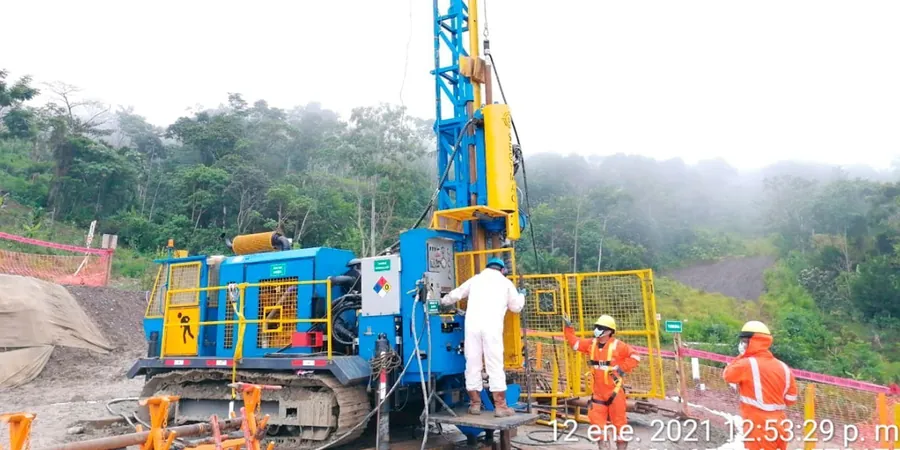
When SPT refusal is encountered in gravel or chalk, the same rig switches to rotary coring without demobilisation. This is the standard approach for Basingstoke sites where the chalk surface is variable and core recovery matters for foundation design.
SPT Monitoring During Piling
For CFA and driven piling projects across Basingstoke, we provide SPT verification boreholes adjacent to pile positions. The data confirms design assumptions and satisfies NHBC requirements for piled foundations in shrinkable clay areas.
Typical parameters
Questions and answers
How much does an SPT borehole cost in Basingstoke?
For a single SPT borehole to 10 metres depth in Basingstoke, budget between £440 and £670 plus VAT. The final figure depends on access conditions, the number of SPTs required per borehole, and whether rotary follow-on is needed if chalk refusal is encountered. Mobilisation within Basingstoke is typically included.
What depth should SPT boreholes reach for a two-storey house extension in Basingstoke?
Building Control in Basingstoke and Deane generally expects boreholes to extend to at least 1.5 times the width of the loaded area below foundation level, or until competent ground is proven. In practice, this means 6 to 10 metres for most domestic extensions, deeper if the site sits on made ground or within the influence zone of trees on shrinkable clay.
How do you correct SPT N-values for the Basingstoke area?
We apply the corrections specified in BS EN ISO 22476-3: energy ratio (Er) to N60, overburden pressure to N1(60), and rod length corrections where applicable. For sites in Basingstoke underlain by chalk, we also report the N-value at which refusal occurs and note whether the chalk structure is likely to be Grade I to VI per CIRIA C574.