Our tracked excavator reaches Basingstoke sites within hours. The machine cuts through weathered London Clay to expose the soil profile at depths up to 4.5 metres. You see the strata with your own eyes. No lab delay. A triaxial test later confirms the strength parameters measured on site. Basingstoke’s patchy geology, where chalk outcrops in the south and clay basins dominate the north, demands this direct approach. Test pits eliminate guesswork when planning foundations near the River Loddon floodplain or the M3 corridor developments. The method works fast on tight residential plots in Hatch Warren and on open commercial land in Basingstoke’s industrial estates.
Most foundation surprises in Basingstoke come from unmapped chalk dissolution features. A test pit reveals them before the concrete pour.
Our approach and scope
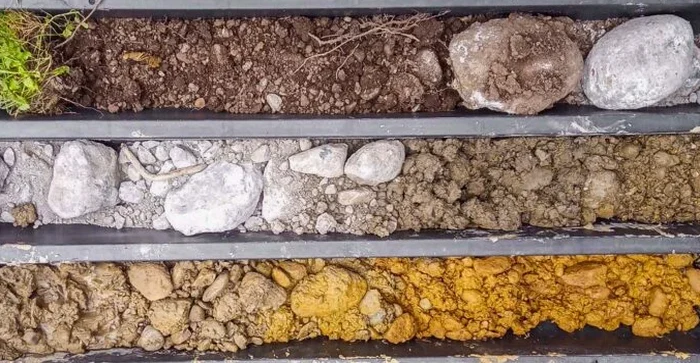
Site-specific factors
Basingstoke’s post-war expansion turned farmland into housing estates at record speed. Old brick pits and chalk quarries were filled in and built over. Records are incomplete. A test pit catches these buried hazards before an excavator bucket hits a void or a soft fill pocket under a new extension. The clay in north Basingstoke shrinks and swells with the seasons. The chalk in the south dissolves along joints and bedding planes. Test pits expose both conditions directly. No indirect geophysics, no speculation. The method is the cheapest insurance a developer can buy against redesign costs and party wall disputes in Basingstoke’s densely built Victorian terraced streets.
Relevant standards
BS 5930:2015 + A1:2020, BS EN 1997-2:2007 (Eurocode 7 Part 2), BS 1377-9:1990 (In-situ tests)
Other technical services
Trial Pitting with Geotechnical Logging
Excavation to 4.5 m depth with continuous soil profiling by a geotechnical engineer. Logs include strength index tests and photographic records.
Infiltration Testing in Test Pits
Soakaway tests per BRE Digest 365 directly in the pit base. Essential for drainage design on Basingstoke’s low-permeability clay sites.
Sampling for Laboratory Analysis
We take Class 1 to 5 samples from the pit walls and base for strength, consolidation, and chemical testing at our UKAS-accredited lab.
Typical parameters
Questions and answers
How much does an exploratory test pit cost in Basingstoke?
A standard test pit in Basingstoke typically costs between £440 and £740. The price depends on depth, access constraints, and the number of samples required for lab testing.
How many test pits do I need for a house extension in Basingstoke?
For a single-storey rear extension, one pit near the proposed foundation line is usually enough. Two pits are better if the site slopes or if the soil changes across the plot, which is common near the clay-chalk boundary in Basingstoke.
Can you dig a test pit close to an existing building?
Yes. We position the pit at least 1.0 m from the existing foundation to avoid undermining. In Basingstoke’s Victorian terraces with shallow footings, we often adjust the pit dimensions to maintain safe clearance while still exposing the bearing stratum.