Road geotechnics in Basingstoke ensures pavement structures perform reliably on the region’s variable London Clay, chalk, and river terrace deposits. Early ground investigation is critical to manage shrink-swell behaviour and bearing capacity risks, forming the basis for designs that comply with the Design Manual for Roads and Bridges (DMRB) and local specifications. A thorough CBR study for road design quantifies subgrade strength, directly influencing layer thickness and material selection for both flexible pavement and rigid pavement solutions.
This discipline underpins residential estate roads, commercial access ways, and highway improvement schemes across Basingstoke, where poor ground often demands stabilisation or capping layers. Integrating a precise CBR study for road design with targeted pavement analysis prevents premature rutting and cracking, delivering durable carriageways that meet long-term maintenance requirements.
Anchor design in Basingstoke separates the unbonded length from the fixed anchor to transfer load beyond the active failure wedge, verified through creep and relaxation testing per BS 8081.
Our approach and scope
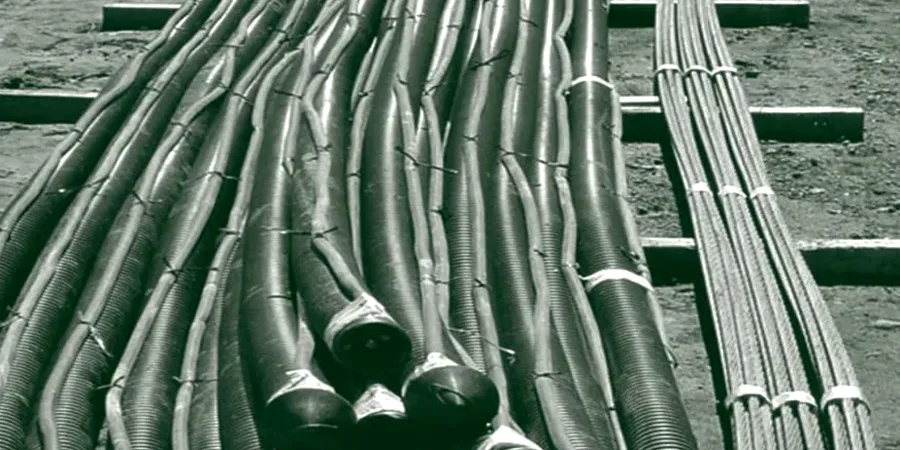
Design loads typically range between 150 kN and 600 kN per strand, with the unbonded length extending a minimum of 1.5 metres beyond the theoretical slip surface. Corrosion protection follows the Grade K requirements of BS EN 1537:2013, employing double-corrugated HDPE sheathing and factory-bonded epoxy coatings for permanent installations. Acceptance criteria are derived from creep rate thresholds during extended creep tests, typically not exceeding 1 mm per log cycle of time under the maximum proof load, ensuring long-term prestress retention in the variable ground conditions of the Hampshire Basin.
Site-specific factors
Basingstoke's post-war expansion, particularly the rapid development of estates like Popley and Oakridge during the 1960s and 1970s, often proceeded with limited geotechnical records for the deeper strata. Retaining structures from that era, especially those supporting road overpasses and underpasses along the Ringway, now show signs of distress due to inadequate drainage behind the facing and progressive corrosion of mild steel tie-backs installed without modern encapsulation.
A forensic review of existing anchored systems in the town frequently identifies grout-to-ground bond degradation in chalk where dissolution features have enlarged over decades, allowing groundwater to circulate and leach cement paste. Current anchor designs for remedial works must therefore assess the aggressivity of the ground environment according to BRE Special Digest 1, specifying stainless steel or epoxy-coated prestressing steel where sulfate and chloride levels exceed the thresholds for carbon steel. The risk of progressive collapse in a multi-anchor wall is mitigated by designing each anchor as a demonstrably testable element, with load cells and tell-tale extensometers installed on representative anchors for long-term monitoring.
Video resource
Relevant standards
BS 8081:2015 — Code of practice for grouted anchors, BS EN 1537:2013 — Execution of special geotechnical work: ground anchors, BS EN 1997-1:2004 (Eurocode 7) — Geotechnical design, anchored retaining structures, CIRIA C574 — Engineering in Chalk, BRE Special Digest 1 — Concrete in aggressive ground
Other technical services
Anchor Design and Tendon Specification
Complete anchor design package including determination of fixed and unbonded lengths, strand configuration, grout mix design for the target bond stress, and corrosion protection specification to BS EN 1537 Grade K for permanent installations in Basingstoke's variable chalk and clay strata.
On-Site Suitability and Acceptance Testing
Supervision and interpretation of investigation tests, suitability tests, and production anchor acceptance tests. Load-extension curves and creep rate analysis are processed on-site to confirm the design bond stress is achieved before lock-off.
Remedial Anchor and Monitoring Design
Design of replacement tie-backs for distressed retaining structures, including assessment of existing corrosion levels, ground aggressivity classification per BRE SD1, and specification of long-term load monitoring with vibrating wire load cells for critical walls.
Typical parameters
Questions and answers
What is the difference between active and passive ground anchors for a Basingstoke basement?
Active anchors are prestressed during installation, locking off a tensile load against the wall to immediately restrain ground movement. They are typically specified for retaining walls supporting sensitive structures or roads where even minor deflections are unacceptable. Passive anchors are not prestressed; they mobilise resistance only as the ground begins to deform, making them suitable for temporary works or where some controlled movement is permissible. In Basingstoke's London Clay, passive anchors often rely on post-grouting to improve the bond strength at the grout-clay interface.
How much does anchor design and testing cost for a project in Basingstoke?
Anchor design and testing services in Basingstoke typically range from £720 for a single-anchor investigation test programme with basic design parameters, up to £3,230 for a full multi-anchor production design package including suitability testing, creep analysis, and long-term monitoring specification for a permanent retaining wall. The final cost depends on the number of anchors, the required corrosion protection grade, and whether investigation tests must be carried out to destruction to confirm ultimate bond stress.
What ground investigation data is needed before designing anchors in chalk?
Anchor design in Basingstoke's chalk requires detailed information on the chalk grade (structureless to blocky, per CIRIA C574), the presence and depth of solution features or dissolution pipes, groundwater level and seasonal fluctuation, and the point load strength index or UCS of the chalk at the proposed fixed anchor depth. Borehole data from SPT or rotary cored drilling through the full anchor zone, plus laboratory index testing on the chalk, provide the parameters needed to calculate the grout-to-ground bond stress and define the unbonded length beyond the critical slip surface.