A recent basement excavation off Winchester Road hit groundwater two metres earlier than the desk study predicted. The contractor had planned a cantilever wall, but the sudden inflow combined with softened London Clay at the toe made that option unworkable overnight. That scenario repeats across Basingstoke more often than reports suggest. The town sits on a transition zone: chalk of the North Downs to the south, the London Clay Formation across the centre, and pockets of river terrace gravels along the Loddon tributaries. Each material imposes a completely different lateral earth pressure profile, which means the retaining wall design has to be tuned to the specific geology encountered in the borehole, not to a generic suburban assumption. Where the gravel lenses are thin, we often combine the retaining wall analysis with slope stability checks to make sure the global failure surface does not daylight behind the wall stem.
In Basingstoke, the difference between a wall that leans and one that stands for decades is usually the drainage detail, not the concrete section.
Our approach and scope
Site-specific factors
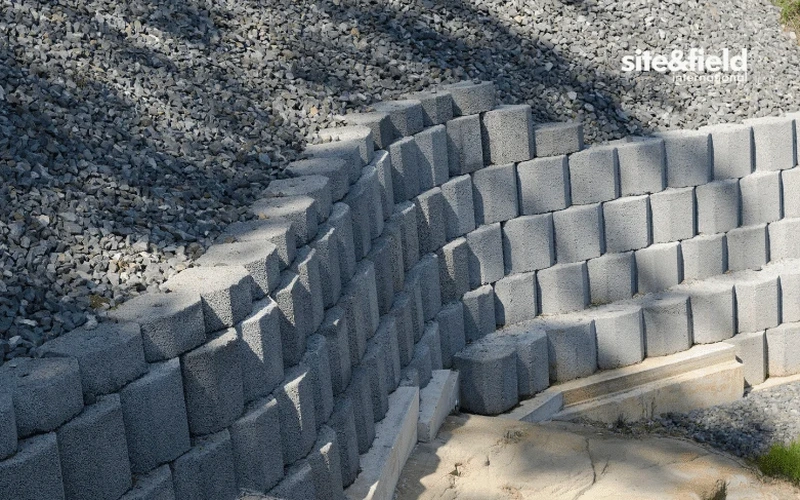
A retaining wall in Basingstoke rarely fails by overturning in the textbook sense. What we see is progressive tilt caused by clay softening at the base combined with silt build-up behind the wall that blocks the weep holes. Once the drainage path is obstructed, water pressure builds, the effective stress in the backfill drops, and the wall starts to rotate forward. This mechanism is particularly common on the gentle slopes north of the M3 where landscaping has altered natural drainage lines. The second risk is under-design of the passive zone in chalk. Intact chalk offers excellent passive resistance, but if it has been disturbed by previous excavation or is structureless Grade D material, the resistance can be one-third of the assumed value. A site investigation that stops at five metres when the wall toe is at four is not enough; we need at least two metres of proven competent material below the founding level, verified by core logging and point load tests.
Relevant standards
BS EN 1997-1:2004 (Eurocode 7 – Geotechnical design), BS 5930:2015+A1:2020 (Code of practice for ground investigations), BS 8002:2015 (Code of practice for earth retaining structures)
Other technical services
Ground Investigation for Wall Design
Rotary and cable percussion boreholes with SPTs, UT100 undisturbed sampling in clay, and laboratory triaxial testing to define the effective stress envelope. We log chalk structure according to CIRIA C574 and install standpipe piezometers to establish the design groundwater level.
Structural and Geotechnical Wall Analysis
Limit equilibrium and finite element analysis using Oasys Frew or PLAXIS 2D. We check overturning, sliding, bearing capacity, and global stability for both temporary and permanent conditions, including seismic pseudo-static analysis where required by the client's brief.
Construction Support and Monitoring
Review of contractor submittals, inspection of foundation stratum prior to blinding, and installation of inclinometer casings or survey targets to monitor wall deflection during backfilling. We provide as-built verification against the design assumptions.
Typical parameters
Questions and answers
How much does a retaining wall design cost for a typical Basingstoke residential project?
For a straightforward garden retaining wall up to about 1.5 metres retained height, including a site visit, limited investigation, and a design package with calculations and drawings, the fee typically falls between £750 and £1,600. For larger commercial walls exceeding three metres or requiring deep foundations, the full design service including ground investigation, analysis, and construction support usually ranges from £1,800 to £3,240, depending on the complexity of the ground conditions and the number of design situations that need to be checked.
Do I need planning permission for a retaining wall in Basingstoke?
Under the Town and Country Planning Act, a retaining wall that is part of an engineering operation may require planning permission if it exceeds one metre in height and is adjacent to a highway, or two metres elsewhere. Basingstoke and Deane Borough Council also considers the visual impact in conservation areas. Our design package includes the technical documentation that planning officers typically request, such as cross-sections, drainage details, and a geotechnical design statement.
How long does the design process take from instruction to issuing the construction package?
A typical programme runs four to six weeks. The first two weeks cover the ground investigation: mobilising a drilling crew, completing the boreholes, and installing piezometers. Laboratory testing takes another week. The remaining two to three weeks are for analysis, drafting, and internal review. Projects requiring party wall agreements or third-party checking by Building Control may add an extra week to the programme.