The chalk valleys and London Clay outcrops around Basingstoke create real challenges for earthworks contractors. Moisture content swings dramatically between the wet winters and the drier chalk downland summers. That is why we run both Standard and Modified Proctor compaction tests before any fill placement begins. Getting the maximum dry density and optimum moisture content right prevents differential settlement later. On a recent M3 corridor logistics project, the imported fill needed Modified Proctor verification at every 500mm lift. Without that data, the building control sign-off would have stalled. Our lab runs BS 1377-4 compliant tests with full reporting within 48 hours. For projects requiring deeper stratigraphic control, we often combine this with in-situ density testing to verify field compaction against the lab curve.
A single-point field density test without the full five-point Proctor curve is just a number, not a quality control decision.
Our approach and scope
Site-specific factors
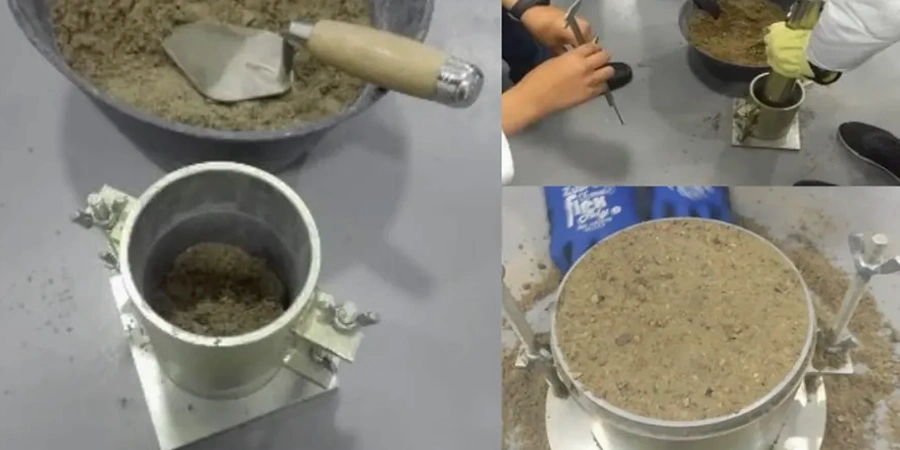
The compaction rammer is a simple machine but it is unforgiving. A worn rammer face or a bent guide sleeve throws the energy calibration off. We check our equipment against a calibrated balance every month. Basingstoke's chalk-rich fills present a specific risk. If chalk is compacted too wet, it crushes and pore pressures build up. If it is too dry, it stays fluffy and settles under traffic. The Proctor curve identifies that narrow moisture window. On one housing scheme near Popley, the contractor tried to use Standard Proctor for a road sub-base. The pavement failed within two years. Modified Proctor would have been the correct specification. We advised the council's engineering team on the remedial design. The lesson cost them. It will not cost you.
Relevant standards
BS 1377-4:1990, BS 6031:2009 (Code of practice for earthworks), Specification for Highway Works (SHW) Series 600
Other technical services
Standard Proctor (BS Light)
Determines the maximum dry density and optimum moisture content for lightly loaded fills, garden areas, and landscaping. Uses the 2.5 kg rammer as specified in BS 1377-4.
Modified Proctor (BS Heavy)
Simulates the compactive effort of heavy vibratory rollers for road sub-base, industrial hardstanding, and structural fill platforms. The 4.5 kg rammer provides a higher reference density.
Moisture-Density Relationship Audit
Review of existing compaction data, re-testing of suspect fill, and independent verification for party wall agreements or building control disputes in Hampshire.
Typical parameters
Questions and answers
What is the difference between Standard and Modified Proctor?
Standard Proctor uses a 2.5 kg rammer dropped 300 mm. Modified Proctor uses a 4.5 kg rammer dropped 450 mm. The Modified test applies about 4.5 times more compactive energy and produces a higher maximum dry density at a lower optimum moisture content. It better represents modern heavy compaction equipment.
How much does a Proctor test cost in Basingstoke?
A single-point Proctor compaction test typically ranges from £90 to £180 depending on whether you need the Standard or Modified method and how many points on the curve are required. A full five-point curve with air voids lines sits at the upper end of that range.
How long does the laboratory test take?
Standard turnaround is 24 to 48 hours from sample receipt. We can expedite results within the same working day if samples arrive before 10 am and you request priority processing.
What sample size do you need for a Proctor test?
We need approximately 25 kg of disturbed material for a Standard Proctor in a 1-litre mould. For Modified Proctor in a 2.3-litre mould, allow 35 to 40 kg. The sample must be representative and bagged to preserve natural moisture content.
Can you test chalk fill from Basingstoke's chalk pits?
Yes. Chalk requires careful handling. We follow the recommendations in CIRIA C574 for chalk earthworks. The Proctor test on chalk is valid but we also assess chalk crushing and saturation behaviour to avoid specifying an unachievable density on site.